


Guangzhou A.C.T Products Co.,Ltd To Make The Global Delivery More Efficient
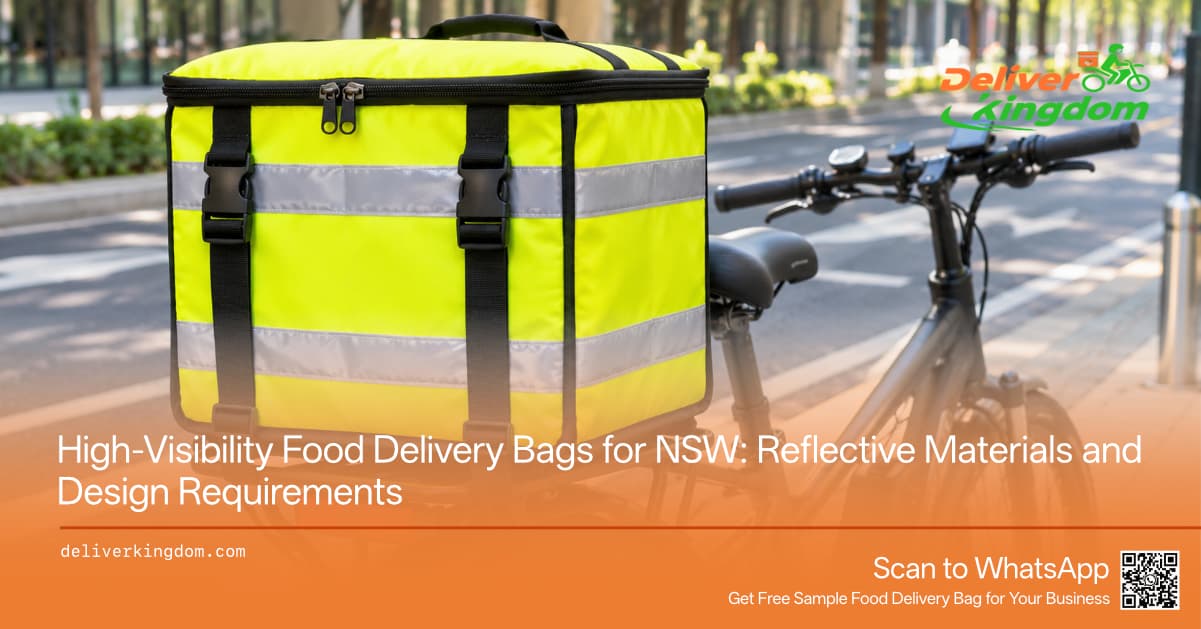
A food delivery bag on a bicycle or motorcycle is not only a closed compartment for hot or cold orders. In traffic, the bag is also a moving surface that other road users see from the front, the side, or the rear, depending on how the bag is carried. Platforms and fleets that supply bags in New South Wales have to brief both jobs at once: the bag has to carry food safely, and it has to be specified as high-visibility personal protective equipment under the current work health and safety rules for food delivery riders. Ordering a standard insulated bag and adding a logo later does not, by itself, complete that second job.
The current instrument is the Work Health and Safety Regulation 2025. SafeWork NSW’s legislation page records that this regulation commenced on 22 August 2025, remaking the 2017 regulation, and that Part 4.10, Food delivery riders, was reordered. The current section numbers include section 184M, Definitions; section 184P, Duty to supply personal protective equipment; and section 184R, Duty to use or wear high-vis personal protective equipment. SafeWork NSW’s legislation page was checked on 24 November 2026.
SafeWork NSW’s food delivery industry page and the current Transport for NSW food delivery riders page set out the operational duties a bag program has to take into account. Both pages were checked on 24 November 2026. From 1 July 2022, food delivery platforms are required to supply riders with high-visibility PPE. That equipment includes a retroreflective outer clothing item, such as a vest, and a bag or container used to transport food or drink, and the garment and the delivery bag must comply with the relevant Australian Standard. The supply duty is not unconditional: a platform does not need to provide PPE if the rider is able to use PPE already provided by another platform. From 1 January 2023, riders are legally required, while delivering food or drink, to use or wear the PPE provided to them. The same Transport for NSW riders page also states that, from 1 January 2023, platforms must give riders induction training before they start work.
The 2023 Transport for NSW guidance note “Providing high-visibility delivery bags to food delivery riders,” checked on 24 November 2026, used different wording for the supply date, stating that as of 1 January 2023 food delivery booking providers are legally required to supply that high-visibility PPE, including the bag or container. The dates used here follow the 2022 amendment commencement as stated by SafeWork NSW and the current Transport for NSW riders page: the platform supply duty from 1 July 2022, and the rider use-or-wear duty from 1 January 2023.
DeliverKingdom, established in 2013, manufactures insulated and thermal food delivery bags, rider delivery equipment, and related commercial transport bags from a Guangzhou headquarters and a production plant in Yangchun, Guangdong, with about 12,000 square meters of production space and more than 400 staff. For commercial buyers writing a specification, the practical next step is to keep three things distinct: the current statutory duties, the material standard now cited for those duties, and the bag design recommendations in the Transport for NSW guidance note.
A workable brief for a New South Wales program sits on three levels that should not be collapsed into one line that simply says “make a high-visibility bag for Australia.” The first level is the current statutory duty: platforms must supply high-visibility PPE, including the bag or container, subject to the already-supplied PPE exception, the garment and the bag must comply with the relevant Australian Standard, and riders must use or wear the PPE provided while delivering. The second level is the material standard now cited for that regulation. The third is the Transport for NSW bags guidance, which gives design recommendations for fluorescent or retro-reflective bag bodies, added logos, markings and bands, attachment, and night-light clips.
SafeWork NSW’s comparison of the 2025 regulation with the earlier instrument states that the reference to AS/NZS 1906.4:2010, “Retroreflective materials and devices for road traffic control purposes, Part 4: High-visibility materials for safety garments,” is updated to AS/NZS 1906.4:2023, under the same title. The 2023 edition is the current published standard, issued on 23 June 2023; the 2010 edition is superseded. These catalogue pages were checked on 24 November 2026. The official Standards Australia preview for the 2023 edition states that the document provides requirements for materials used in the manufacture of, or incorporated into, garments designed to be worn for high visibility, that it applies to those materials and not to the garments themselves, and that it supersedes the 2010 edition. The Transport for NSW bags guidance, which is a 2023 note, still cites AS/NZS 1906.4:2010 in its band section. A factory brief can record both facts: the guidance note names the 2010 edition for bands, and the material standard now cited for the current regulation, per SafeWork NSW, is AS/NZS 1906.4:2023.
The table below collects the core procurement points and their sources. Later sections take up the construction, layout, attachment, and sampling questions that follow from those points.
| Item | Source |
|---|---|
| Platforms must supply high-visibility PPE, including a retroreflective outer clothing item and a bag or container for safely transporting food or drink. Platform supply duty from 1 July 2022. | Current statutory duty, as stated by SafeWork NSW and the current Transport for NSW riders page (Work Health and Safety Regulation 2025, Part 4.10, including the duty to supply PPE). |
| The garment and the delivery bag must comply with the relevant Australian Standard. | Current statutory duty, as stated by SafeWork NSW. |
| A platform does not need to provide PPE if the rider is able to use PPE already provided by another platform. | Current statutory duty, as stated by SafeWork NSW. |
| While delivering food or drink, riders must use or wear the PPE provided to them. Rider use-or-wear duty from 1 January 2023. | Current statutory duty, as stated by SafeWork NSW and the current Transport for NSW riders page. |
| Material standard now cited for the current regulation: AS/NZS 1906.4:2023, High-visibility materials for safety garments. The standard applies to those materials, not to finished garments themselves, as stated on the Standards Australia preview for the 2023 edition. | Cited Australian material standard, per SafeWork NSW’s comparison of the 2025 regulation with the earlier instrument. |
| Bags made entirely of bright fluorescent or retro-reflective material; the best colours to use are yellow, orange or light green. | Transport for NSW bags guidance. |
| If the bag is not entirely made of those materials: retro-reflective logos/markings and/or bands on the front, sides and straps. | Transport for NSW bags guidance. |
| Logos and markings made entirely of retro-reflective material and a bright fluorescent colour, such as white, yellow or silver, and large enough to be visible to other road users from a distance. | Transport for NSW bags guidance. |
| Bands made from compliant retro-reflective materials and/or specified to meet AS/NZS 1906.4:2010; at least 40 mm wide; long enough to cover the complete width of the bag; placed on all outward-facing sides, including the shoulder straps; at least two retro-reflective bands on each outward-facing side. | Transport for NSW bags guidance. The note cites the 2010 edition for bands; the material standard now cited for the current regulation, per SafeWork NSW, is AS/NZS 1906.4:2023. |
| Able to be securely strapped to the bicycle or to the rider. | Transport for NSW bags guidance. |
| Additional clips to securely attach a light for added visibility at night. | Transport for NSW bags guidance. |
| Comply with the relevant Australian Standard. This guidance bullet does not name the standard. | Transport for NSW bags guidance. |
The fluorescent colours, band width, complete-width length, two-band count, strap placement, bicycle or rider attachment, and night-light clips in that table come from the Transport for NSW guidance note. They are recorded here as guidance recommendations, not as mandatory dimensions taken from the 2025 regulation text.
The Transport for NSW bags guidance sets out two constructions for the bag body. One is a bag made entirely of bright fluorescent or retro-reflective material, with yellow, orange, or light green named as the best colours to use. That is a whole-shell decision: the fabric, or the retro-reflective material chosen for the body, is the visibility surface, and color selection is part of the specification, not a decorative extra. The other construction applies when the bag is not entirely made of those materials. In that case, the guidance says the bag should have retro-reflective logos/markings and/or bands on the front, sides, and straps. A dark or brand-colored shell can still be built, but then those added markings have to be planned on the faces the note names.
The two constructions have different consequences on the cutting table. An all-fluorescent or all-retro-reflective body has to be planned as a color and material choice across every outward panel, including faces that will take a zipper, a handle, a clear pocket, or a printed brand mark. Panels that are usually cut from a darker stock in a standard insulated bag have to come from the nominated fluorescent or retro-reflective material, and any print or badge has to sit on that surface without being treated as a substitute for it. Added logos, markings, or bands are instead a placement and material choice on top of a shell that is not itself entirely fluorescent or retro-reflective. They have to be large enough, in the note’s wording on logos and markings, to be visible to other road users from a distance, and they have to sit on the front, sides, and straps.
Buyers who already have a brand color that is not yellow, orange, or light green are not choosing between “a visible bag” and “a branded bag.” They are choosing whether the program will use an entirely fluorescent or retro-reflective body, or whether it will use added retro-reflective logos, markings, and/or bands on a different shell. That choice should be written into the inquiry as a construction decision, together with the shell color and the faces that will carry any fleet mark. Neither construction, by itself, describes how the bag is held on a bicycle or a rider, or where a night-light clip should sit.
Where a program uses bands, the width, length, count, and placement conditions, and the material wording in the guidance note, are set out in the table above. The manufacturing problem is how those bands sit on the bag that is actually carried in traffic. What is outward-facing depends on the carry method. A bag worn on the rider presents the back of the pack to following traffic, the sides at intersections, and the shoulder-strap lengths that face forward, to the side, or to the rear as the rider turns. A bag strapped to a bicycle presents the faces that remain visible once the bag is fixed to the frame or the rack; straps that are stowed, or that sit against the rack, are no longer a street-facing surface, while the rear and side panels usually are.
Hardware on those same faces will decide whether a band can run the complete width of a panel, and whether a second band still has a clear path. A vertical zipper, a top flap, a grab handle, a clear pocket, or a 3D logo badge can break a band or occupy the only area where the second band would sit. A layout should therefore be drawn on the actual carry method, with the zipper line, handles, and any brand mark already in place, rather than on a flat bag outline alone.
The guidance note says Figure 1 and Figure 2 show the best placement for retro-reflective bands. The photographs on that page are not individually labelled with those figure numbers, so a factory brief should work from the official PDF rather than from a reconstructed caption. What is visible on the page is as follows. The left photograph shows the front of a yellow square bag with two horizontal light or silver bands running across the full width of the face, one higher and one lower. The middle photograph shows a yellow box bag from a three-quarter angle, with the two bands continuing around the corner onto the visible side and running the full width of the visible faces, and a handle at the top. The right photograph shows a yellow backpack-style bag from the rear three-quarter: green webbing at the top, two horizontal bands on the rear face, and padded shoulder straps. On those straps, a vertical light or silver strip is visible on the outer face of each pad. A night-light clip is not clearly visible in these photographs. If a program supplies both a motorcycle food delivery backpack and a bicycle-mounted bag, the outward-facing sides and the usable strap lengths should be drawn for each carry method, because they are not the same parts in both setups.
The Transport for NSW bags guidance also recommends that bags be able to be securely strapped to the bicycle or to the rider. That recommendation is about holding the bag itself, not about stitching reflective tape to a panel. The two attachment methods are alternatives in the official wording: to the bicycle, or to the rider. A wearable backpack answers the second method when its harness actually holds the load on the rider in motion and still allows the bag to be taken off at a door if that is how the drop is done. A bicycle-mounted bag answers the first method when its straps or fixings can hold the bag on the bicycle, on the rack or frame the fleet actually uses, without leaving the bag free to swing into a wheel, a pedal, or a lighting cluster.
The manufacturing questions follow from that distinction. A rider-worn bag needs a harness plan: shoulder straps, and whether a sternum strap or waist belt is also required, plus how the bag is taken off and put back on during a shift. A bicycle-mounted bag needs a plan for the strap paths, the contact area on the rack or frame, and whether the bag stays on the bicycle while it is opened or is lifted off at the stop. A hybrid program that sometimes wears the bag and sometimes straps it to the bicycle needs both plans, and it needs to say whether the same unit must do both jobs or whether two constructions will be ordered.
Buyers should describe the vehicle and the carry method in the inquiry, rather than asking for a generic “secure bag.” A strap system designed for a backpack harness will not automatically fit a bicycle rack, and rack straps will not automatically hold the same bag on a rider. Secure attachment also has to be planned around the band paths and any night-light clip, so a rack strap does not cover a band that is meant to remain visible, and so a harness buckle does not sit where a clip is needed.
The bags guidance includes a further recommendation: bags should have additional clips to securely attach a light for added visibility at night. Those clips are a feature of the bag. They are not a substitute for the lights and reflectors that belong on the bicycle or the motorcycle, and they are not the same thing as retro-reflective bands. The clip has to be placed where a light can be attached securely, where it remains usable once the bag is worn or strapped down, and where it does not sit on top of a band path or a zipper pull that the rider needs to open at a door. The guidance note does not specify the clip type, the number of clips, or the light to be supplied with the bag. Those details, if the buyer wants them, belong in the inquiry as a hardware request: how many clips, on which faces, and whether the light itself is in the buyer’s scope or only the attachment point.
Transport for NSW’s food delivery riders page addresses vehicle lighting as its own subject. It states that motorcycle food delivery riders must have their lights on between sunset and sunrise and in bad weather, and that bicycle food delivery riders are required to display appropriate lights and reflectors at night and in hazardous weather conditions. Those points are about the vehicle, not about the bag. A bag program can still add clips so a light can be mounted on the bag; that addition does not complete the vehicle-lighting requirements on the public riders page. Because a night-light clip is not clearly visible in the photographs on the bags guidance page, clip position and hardware should be specified in the brief rather than copied from those images.
Visibility work sits on the outside of a bag that still has to carry food. An insulated compartment, a lining that can be wiped, an opening the rider can use with a loaded bag, and a zipper line that is not left unprotected in rain all remain part of the same product. Fluorescent panels, retro-reflective bands, logos or markings, light clips, and attachment straps now occupy some of the same faces that used to be free for a printed brand, a clear pocket, or a wide zipper. Those items have to be planned together so a band that is meant to run the complete width of a panel is not interrupted by the opening, and so a top or front zipper is still usable when the bag is strapped to a bicycle or worn on the rider.
Material choices should be named in the inquiry as materials, not as performance promises. The outer shell, the insulation, the lining, and the zipper protection can be described in the brief; hold time, temperature drop, and waterproof ratings should not be assumed in the absence of an agreed test. If the bag must fold for bulk shipment, that is a packing request, and it has a tradeoff: boards or a more rigid base can help a loaded bag hold its shape on a rack or on a rider’s back, while a more foldable body can pack flatter in a carton. The inquiry should say which of those matters more for the program, rather than asking for both as if they had no effect on each other.
Brand marks belong in the same planning step. A printed logo or a PVC badge can be placed on a face that also needs two retro-reflective bands, or a retro-reflective marking large enough to be seen from a distance. If both are required, the drawing should reserve space for each. Leaving the logo until after the visibility layout is finished is how a mark ends up sitting on a band, or a band ends up short of the complete panel width.
Buyers often arrive with a tape specification of their own, a preferred fluorescent fabric, or a test report already issued on a roll of material. Those documents are useful in a factory brief, but they do not automatically take the place of the material standard cited for the current New South Wales regulation. A custom specification can describe the tape or fabric the buyer wants the factory to purchase and sew; it does not, by itself, replace AS/NZS 1906.4:2023 where that standard is the reference now cited for the regulation, and it does not convert a guidance recommendation into a statutory dimension.
A material test report has a similarly limited reach. It describes the material that was tested, under the conditions of that report. It does not automatically prove that a finished bag satisfies every applicable duty: it does not, by itself, establish that the sewn bag still presents the intended visible area once zippers, straps, and badges are in place, that the bag can be securely strapped to the bicycle or to the rider, that light clips are fitted where the brief requires them, or that the platform’s supply and use-or-wear duties have been met. DeliverKingdom can review material documents for the fluorescent fabric or the retro-reflective tape under discussion and can manufacture to a named standard or to an attached buyer specification. Those documents still describe materials. Whether a finished bag meets a duty in New South Wales is for the buyer and the competent authority.
Sample scope should be stated with the same distinction in mind. A fabric and tape swatch can show color and the look of a band on a flat piece of shell, and it can be compared with the material documents on file. A complete sewn bag is the piece that shows whether two bands still run the complete width of each outward-facing side once zippers, straps, clips, and attachment points are in place, and whether the bag can actually be strapped to the intended bicycle or worn by the rider. The sample answers a construction question. It is not a substitute for the buyer’s own determination against the current regulation and the official guidance.
DeliverKingdom works as an OEM and ODM manufacturer on commercial food delivery bags and rider equipment. On a high-visibility program, that work can include helping the buyer select shell and tape materials against the brief, drawing a reflective-band layout on the actual bag panels and strap lengths, making swatches and complete sewn samples, reviewing material documents supplied for the fabrics or tapes under discussion, and then moving the agreed construction into bulk production.
Material selection is a purchase and cutting decision. The buyer can nominate a fluorescent yellow, orange, or light-green shell, a retro-reflective body material, or a different shell color that will carry added markings; the factory can source and cut those materials, and can identify where a zipper tape, a handle, or a lining will meet the visible shell so the join is planned rather than improvised at the sewing line. Band layout is a panel drawing: the path of each band on each outward-facing side, including visible shoulder-strap lengths for a worn pack, the clearance around zippers and attachment points, and the reserved area for any fleet mark. A drawing of that kind is what a sample is sewn from, and it is also what a bulk cutting ticket can follow.
Once the construction is agreed, bulk production follows the approved sample and the written brief, including packing for the destination and whether the bags must fold in the carton. Sample cost, production timing, packing, and freight details are confirmed with the sales team against that agreed construction, rather than taken from a generic list. The inquiry is more useful when it attaches the official guidance the buyer wants the factory to work from, names the material standard or buyer specification the tape or fabric should follow, and states the carry method, because those three inputs are what material selection, layout, sampling, and production actually run on.
A workable inquiry describes the program and the bag in the same brief, and it can attach or cite the source table above. It should state the order quantity and the destination, which are confirmed with the sales team, and it should say whether the bag is worn by the rider, strapped to a bicycle, or required in both forms. It should name the bag-body construction: an entirely bright fluorescent or retro-reflective shell, with the color chosen from yellow, orange, or light green if that is the intended build, or a different shell color with retro-reflective logos, markings, and/or bands on the named faces. If bands or markings are required, the brief should attach or cite the guidance and the material standard or buyer specification the tape should follow, and it should include a panel drawing for the actual carry method.
Attachment hardware, light-clip quantity and position, the insulated compartment and opening path, rain protection as a material and zipper treatment, and branding—including any conflict with band or marking areas—should be included in the same drawing or description. Packing for bulk shipment, including whether the bags must fold in the carton, can be added so quotation and freight are based on the actual construction. Logo placement, unbranded supply, or a reserved area for a fleet mark should be stated rather than left for the sample stage. A quotation is firmer when those points arrive together.
Q: What high-visibility duties apply to food delivery platforms and riders in New South Wales?
A: Under the current Work Health and Safety Regulation 2025, as summarized by SafeWork NSW and the current Transport for NSW food delivery riders page, platforms have been required since 1 July 2022 to supply riders with high-visibility PPE, including a retroreflective outer clothing item and a bag or container for transporting food or drink. The garment and the delivery bag must comply with the relevant Australian Standard. A platform does not need to provide PPE if the rider is able to use PPE already provided by another platform. From 1 January 2023, riders are legally required, while delivering food or drink, to use or wear the PPE provided to them. The official instrument, the SafeWork NSW pages, and the Transport for NSW riders page should be read for the current wording.
Q: Are the band width, complete-width length, two-band count, and light-clip details mandatory dimensions in the 2025 regulation text?
A: Those construction details appear in the Transport for NSW guidance note “Providing high-visibility delivery bags to food delivery riders,” which also cites AS/NZS 1906.4:2010 in its band section. They should be treated as guidance recommendations, not as mandatory dimensions taken from the 2025 regulation text. The material standard now cited for the current regulation, per SafeWork NSW, is AS/NZS 1906.4:2023. A factory brief can record the guidance recommendations and the current standard citation as the separate references they are.
Q: If a buyer supplies a custom tape specification or a material test report, does that replace AS/NZS 1906.4:2023 or prove that the finished bag meets every applicable duty?
A: No. A buyer-supplied custom material specification does not automatically replace the applicable statutory material standard. A material test report describes the material that was tested; it does not automatically prove that a finished bag satisfies every applicable duty, including layout in use, attachment, and the platform’s supply and use-or-wear obligations. DeliverKingdom can review material documents and manufacture to a named standard or to an attached specification. Whether a finished bag meets a duty in New South Wales is for the buyer and the competent authority.
Q: What can DeliverKingdom help with on a high-visibility food delivery bag program?
A: DeliverKingdom can help with material selection for the shell and the tape, reflective-band layout on the actual panels and strap lengths, sample making—including fabric and tape swatches and complete sewn bags—review of material documents for the fabrics or tapes under discussion, and bulk production of the agreed construction. Which sample is produced, and on what schedule and terms, is confirmed with sales for the construction under discussion.
Q: How are order quantity, packing, and shipment handled for a bulk order?
A: Order quantity, packing method—including whether the bags must fold in the carton—and shipment details are confirmed with the sales team for the agreed construction and destination. The quantity the program actually needs should be included in the inquiry so it can be confirmed against that build.

 Richiedi un preventivo online
